
Corporate Updates
Turning the Sense of Touch into Data: PHAIN Launches G03 Pro / ProT Data Gloves

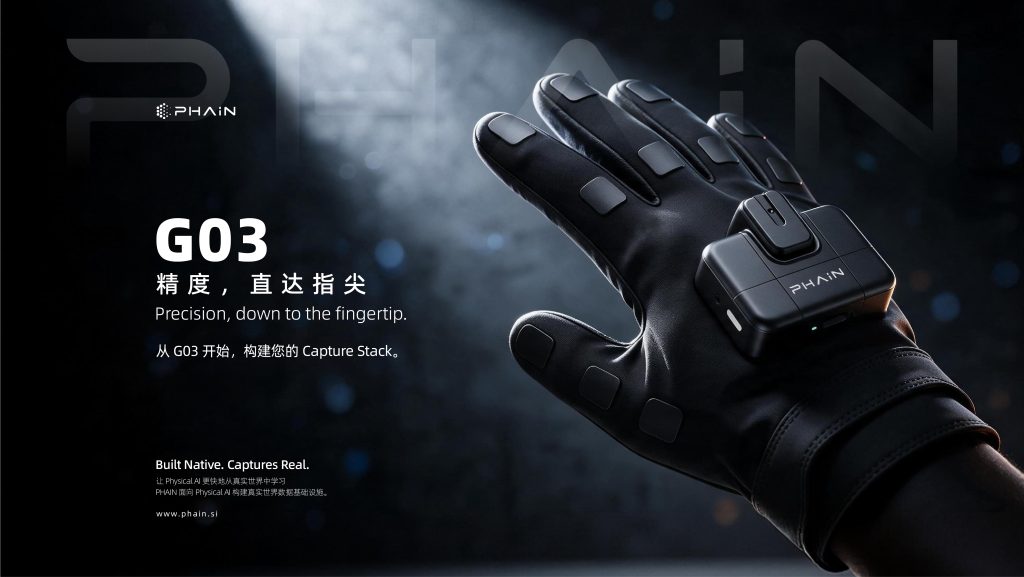
On October 20, at the 2026 Physical AI and World Models Conference in Nanjing, PHAIN officially unveiled its G03 Pro and G03 ProT data gloves, alongside PHAIN Sense, a capture layer comprising data gloves, wrist-mounted cameras, first-person vision devices, and a multimodal controller. Building on this launch, the company outlined PHAIN Stack, its integrated architecture spanning capture, understanding, and evolution, designed to serve embodied AI foundation model companies and build native data infrastructure for embodied intelligence.
This architecture centers on one question: as more real-world data is collected, how much can actually enter training and translate into model capabilities? PHAIN focuses on the full lifecycle cost per unit of usable data. Through five core product capabilities—high precision, multimodal sensing, interference resistance, automotive-grade quality, and scalable delivery—it addresses gaps in quality, diversity, and scale, making every hour of capture yield usable data for specific scenarios.
As Data Volumes Grow, What Do Models Still Need?
Embodied AI is entering an era of large-scale data collection. Generalist AI has collected 270,000 hours of real-world manipulation data using wearable devices. Figure has launched crowdsourced first-person data collection via smartphones. JD.com plans to mobilize up to 600,000 people to accumulate 10 million hours of human activity data from real-world settings over two years. Mifeng has delivered 20,000 MEgo capture systems. These different approaches are expanding the supply of data, yet video alone cannot capture all the information needed for dexterous manipulation.
Consider picking up a strawberry. A camera can record the fingers gradually closing, but it struggles to show the exact moment they touch the skin or how much force is applied afterward to hold the fruit securely without crushing it. The fingers may obscure the contact points, while changes in force remain invisible. Sensors placed close to the fingertips and palm can record the contact and pressure involved. Vision describes what the hand is doing; the glove further records what the hand is sensing. Together, they provide complementary information for models learning dexterous manipulation.
World models need to predict what happens next based on the current state and an action. Meta’s V-JEPA 2 first learned to “see” from more than one million hours of video, then used fewer than 62 hours of robot interaction data to learn action-conditioned prediction. This also illustrates the value of interaction data in connecting observation with action.
Current approaches to data supply can be broadly grouped into four layers. L1, robot teleoperation, resembles test vehicles with safety drivers in autonomous driving. Collection typically ranges from hundreds to thousands of hours and is constrained by cost, equipment wear, and safety risks. L2, high-precision human interaction data, resembles ground-truth data collection vehicles and targets tens of thousands to hundreds of thousands of hours. Historically, it has often relied on motion-capture studios, making deployment at scale difficult. L3, crowdsourced first-person and wearable data collection, resembles shadow-mode collection in production vehicles. It can reach millions of hours or more, but lacks force information and fine-grained hand data. L4, internet video and simulation, offers a virtually unlimited source of data, while still facing the simulation-to-reality gap.
PHAIN focuses on the long-standing shortage of high-precision human interaction data: preserving millimeter-level accuracy and force information while moving beyond the laboratory into scalable collection across diverse settings. This requires addressing three gaps at once. Pose errors, environmental interference, and device reliability affect data quality. A single modality cannot fully capture both movement and contact during an operation. Collection methods that depend on fixed facilities or physical robots constrain scale. Accuracy, completeness, and the ability to expand supply together determine whether collected data is ultimately usable.
Five Core Product Capabilities, Built for Training in Specific Scenarios
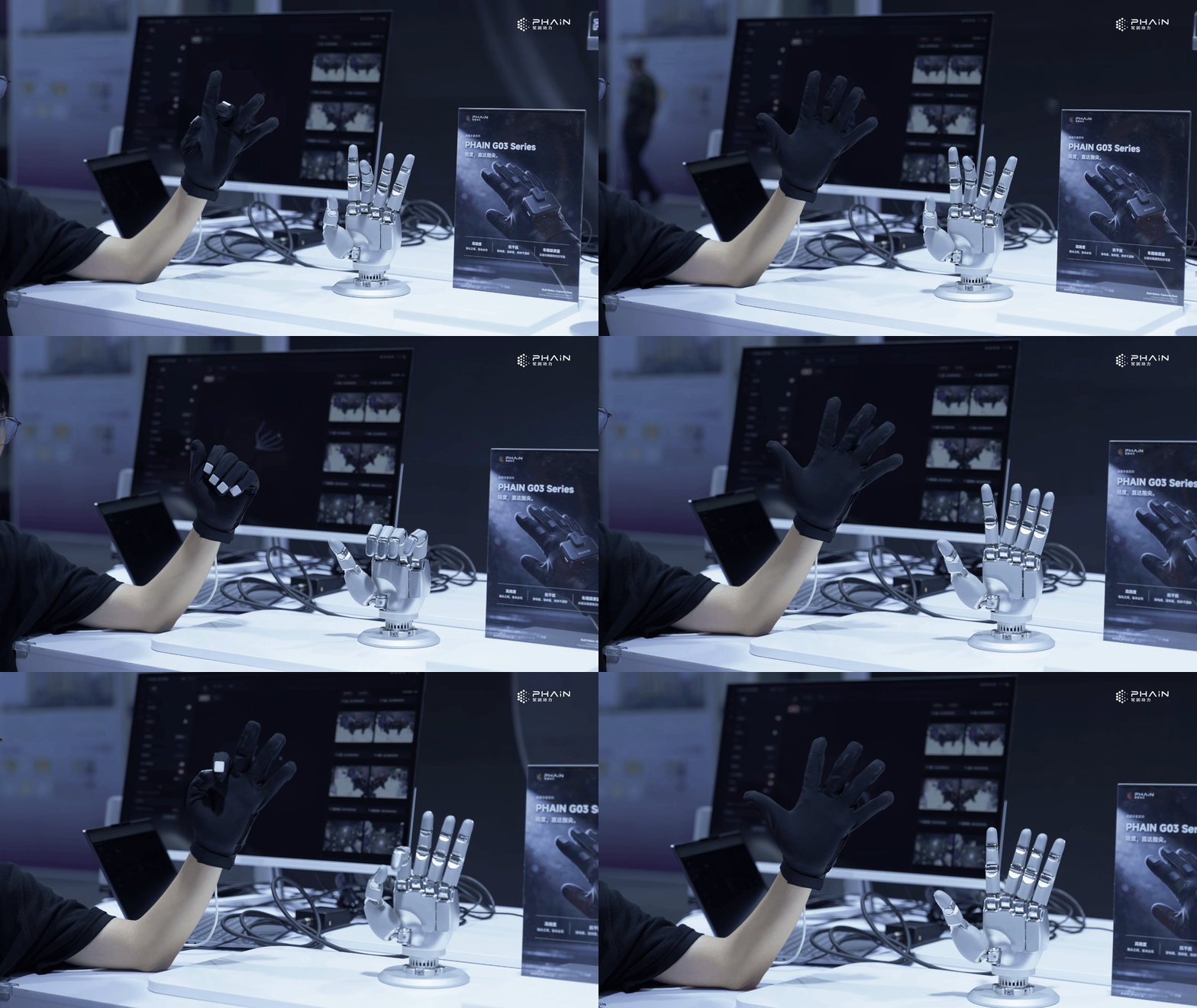
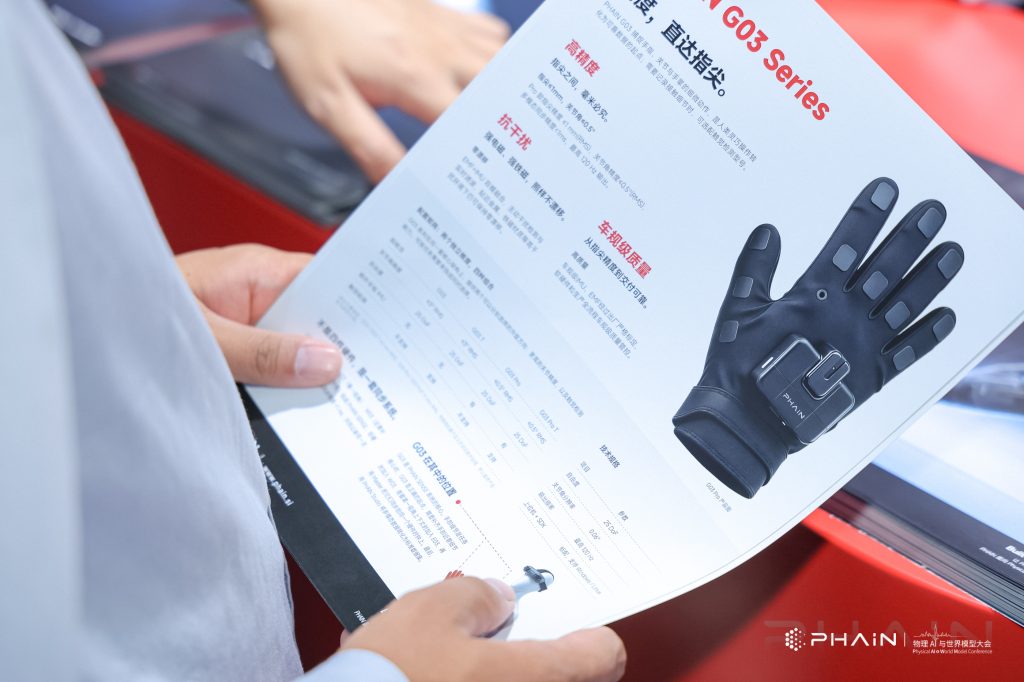
The G03 series is PHAIN’s core standard product line and the hand-data capture entry point into PHAIN Stack. G03 Pro is designed for high-precision hand-motion capture, while G03 ProT adds full-palm tactile sensing for tasks that depend on contact information, such as precision assembly and manipulation of deformable objects. The G03 series supports output rates of up to 120 Hz. Both models come with PC software and an SDK, support custom development on Windows and Linux, and integrate with customers’ existing data pipelines.
High Precision, Down to the Fingertips and Joints
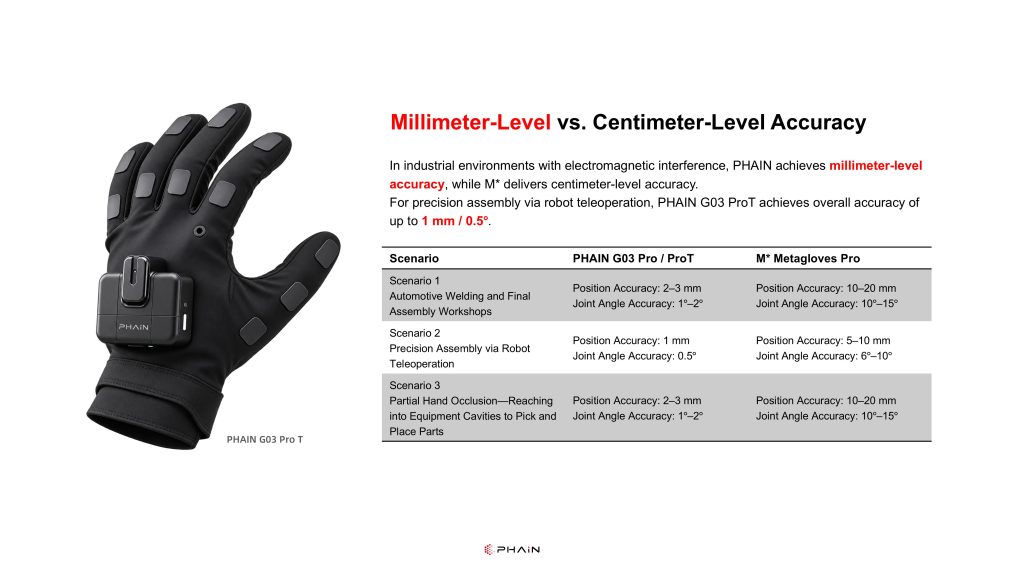
The G03 series provides 25 degrees of freedom to fully reconstruct finger, palm, and wrist poses, with fingertip position accuracy of ≤1 mm (RMS) and joint angle accuracy of ≤0.5° (RMS). This is enabled by multisensor fusion combining IMU, EMF, and human skeletal constraints. Joint ranges of motion and skeletal relationships are incorporated into the estimation process, allowing sensor measurements and the human motion model to constrain each other and suppress implausible pose estimates. Accurate hand-motion capture provides the foundation for reconstructing dexterous operations for model learning.
Multimodal Sensing, Capturing Contact Alongside Motion
G03 ProT uses more than 800 tactile sensing points across the full palm to record contact locations and pressure changes, with a tactile consistency metric of <8%. Tactile and pose data share the same timeline, with multimodal synchronization error below 1 ms. Changes in pressure as a finger touches a strawberry can therefore be matched to the hand’s pose at that moment. Together, pose and tactile sensing describe the manipulation process, capturing information that a single modality cannot adequately represent and providing richer data dimensions for different tasks.
Interference Resistance, Maintaining Precision in Real Working Environments
Motors, metal, and complex electromagnetic conditions in factories can cause drift and abrupt jumps during capture. The G03 series combines EMF and IMU sensing with active interference detection and real-time filtering. When interference occurs, the IMU supports short-term estimation; once interference subsides, EMF provides correction. This maintains zero drift under strong electromagnetic and ferromagnetic interference and enables stable capture even close to metal. Bringing data collection into real working environments gives models access to the operations performed in those settings.
Automotive-Grade Quality, Sustaining Precision Through Long-Term Use
Both the IMU and EMF sensors in the G03 series undergo factory calibration, while automotive-grade quality controls govern the hardware, software, and entire production process. In intensive, extended capture sessions with multiple operators taking turns, device uptime, failure-related downtime, and consistency across units all contribute to the cost of usable data. PHAIN brings device reliability and batch consistency under the same quality requirements, extending quality assurance from individual measurements to sustained data collection.
Scalable Delivery, Extending Stable Capture Across Device Fleets
Automated assembly and calibration enable high performance consistency across G03 units produced in volume. Each glove weighs less than 180 grams and can be put on in under 30 seconds. Its wearable, mobile form requires neither a fixed motion-capture studio nor a physical robot. Compared with robot teleoperation workflows, capture throughput increases by tens of times, while delivery lead times shrink from months to weeks, expanding the supply of high-precision human interaction data.
These five capabilities work together: high precision records motion, multimodal sensing adds contact information, and interference resistance enables operation in real environments. Automotive-grade quality and scalable delivery allow more devices to work consistently over extended periods. Quality, diversity, and scale are thus addressed within the same capture session, across the same device fleet, and through a shared set of data standards.
From a Pair of Gloves to PHAIN Stack
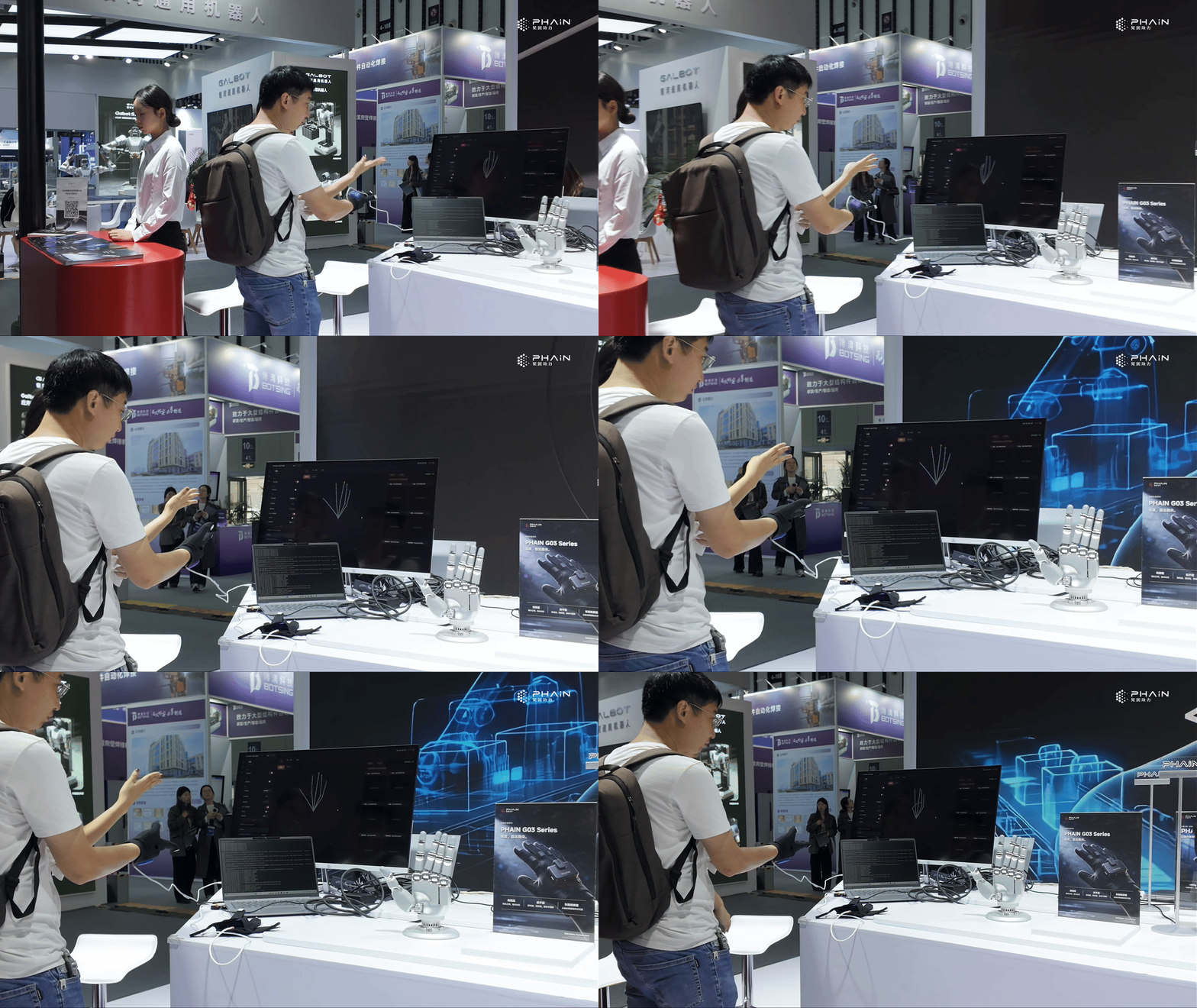
Hand data needs to be recorded alongside the scene seen by the operator to describe real-world manipulation more completely. The newly launched Sense capture layer combines G03 gloves with Wrist cameras, Ego first-person vision devices, and the Master multimodal controller in one capture system.
Wrist records close-up views of hand–object contact, filling blind spots when the operator’s arms obstruct the head-mounted view. Ego uses four fisheye cameras to provide a horizontal field of view exceeding 270 degrees, recording the scene from the operator’s perspective. Master uses Ego as the master clock and coordinates triggering through hardware signals, giving all devices a common time reference. Image-to-IMU synchronization error is below 1 ms, while inter-channel skew within the controller is below 1 μs, aligning different viewpoints, motion data, and tactile signals to the same operation.
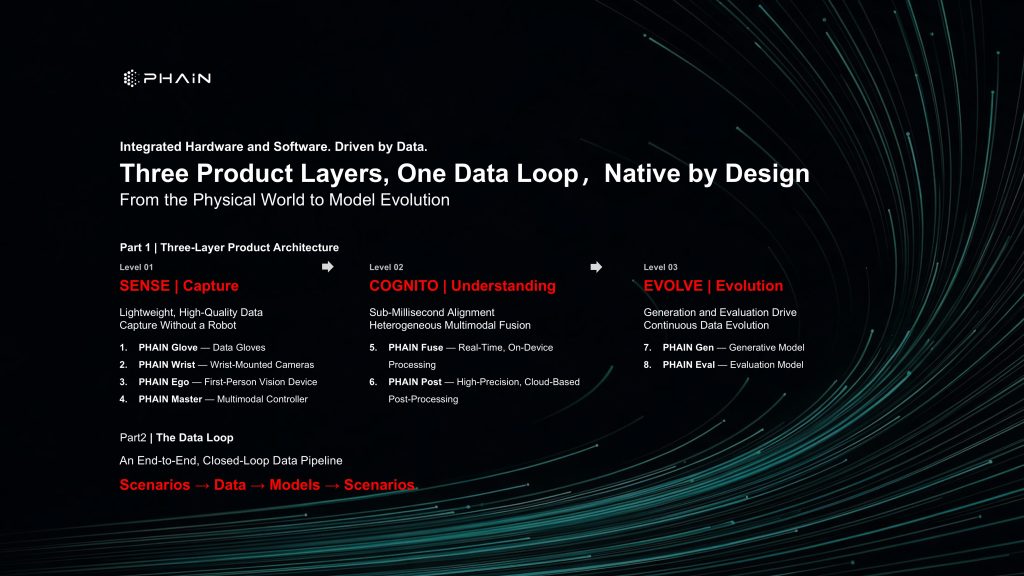
Within the overall PHAIN Stack roadmap, Sense serves as the capture entry point. The Cognito understanding layer and Evolve evolution layer further connect data processing with model feedback, with development of these modules ongoing.
Cognito comprises Fuse and Post. Fuse handles real-time synchronization and fusion-based estimation on the device, while Post provides high-precision post-processing in the cloud. Evolve uses Gen and Eval to connect real-world data with scenario augmentation and performance evaluation. Gen uses captured real-world data as seeds to synthesize long-tail scenarios. Eval connects with customers’ training pipelines to assess the data’s actual contribution to model performance and feed the findings into the next round of collection. Where a model still underperforms, additional data can be captured for the corresponding scenarios, creating a continuous cycle between data collection and model improvement.
This is also why PHAIN emphasizes “native.” Time synchronization, format protocols, and calibration information are incorporated into a unified design from the device onward. Standardization begins at capture, reducing the need for subsequent format conversion, temporal alignment, and missing-information recovery. The data delivery design also includes three-tier confidence annotations, helping customers understand the accuracy and confidence level of each frame. Capture, processing, augmentation, and evaluation are organized around one goal: enabling real-world manipulation data to support model training continuously.
Bringing Methods Proven in Autonomous Driving to Ten Fingers
This architecture builds on accumulated expertise in time alignment, fusion algorithms, and automotive-grade quality. PHAIN is an independent subsidiary of MCT Technology Group. Its parent company’s intelligent driving solutions have been deployed in more than one million vehicles, validated over five billion kilometers, and achieved a market share exceeding 50% in L4 logistics vehicles.
Time synchronization determines whether different signals describe the same moment. The vehicle-side PPS hardware synchronization used in intelligent driving translates into hardware-triggered synchronization at the capture end, accurately associating images, motion, and tactile information. In fusion algorithms, 15 years of multisensor fusion and calibration expertise, together with methods combining GNSS/INS fusion and vehicle motion constraints, extend to multisensor fusion and human motion constraints for fingers, joints, wrists, and the head, suppressing drift and abrupt jumps at the source.
The quality system enables these capabilities to be delivered at scale. From sensor selection and factory calibration to production control, PHAIN applies automotive-grade quality requirements throughout the process. Both its gloves and automotive-grade IMUs are manufactured in-house in Changzhou. Fusion integrity monitoring in intelligent driving informs quality validation and confidence design for embodied AI data. Experience with the collection, annotation, optimization, and OTA feedback loop also provides a methodological foundation for feedback across collection, annotation, training, and deployment.
Together, these capabilities underpin PHAIN’s requirements for data infrastructure: accurate, synchronized, and trustworthy data in every frame; consistent, long-term operation across thousands of devices; and a path for capture results to feed back into model improvement.
Connecting Data to Model Training Through the Cost of Usable Data
For robotics and embodied AI foundation model companies, data value must ultimately be measured against specific tasks. These range from factory operations such as precision assembly and defect sorting to unmanned retail, from household tasks such as cooking, cleaning, and organizing to eldercare and assistance. Across these applications, the criteria remain consistent: capture efficiency, data-cleaning costs, equipment wear, batch consistency, and the data’s actual contribution to model performance together determine the full lifecycle cost per unit of usable data. PHAIN aims to drive this cost to an industry-leading minimum, accelerating embodied AI’s transition from demos to commercial success.
The official launch of G03 Pro / ProT and the Sense capture layer provides a product foundation for PHAIN’s native data infrastructure. As Cognito and Evolve continue to advance, PHAIN will develop the full chain of capture, understanding, and evolution, making every hour of capture yield usable data for specific scenarios.
Physical AI, for everyone!