
Corporate Updates
PHAIN Featured on CCTV News During APEC, Showcasing China’s Homegrown Innovation
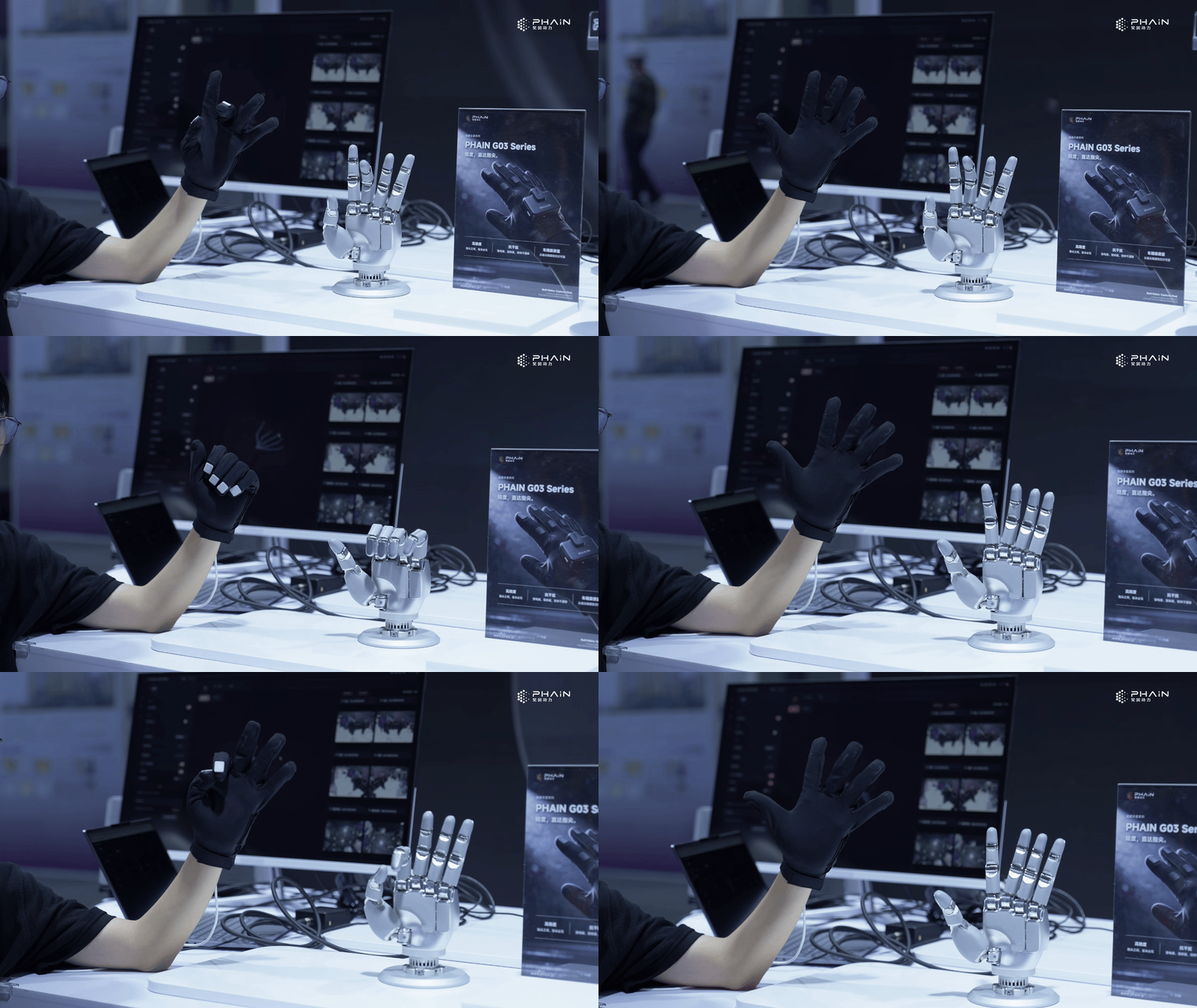
During APEC, PHAIN’s independently developed G03 Pro T data glove was featured on CCTV News’ Let’s Talk APEC (聊会儿APEC). Dr. Peter Bradley Shull, Chief Scientist at PHAIN, wore the glove to demonstrate robotic teleoperation and explain how it collects data for training dexterous robotic hands.
“This is a PHAIN glove.” Dr. Shull introduced the device while discussing the data needed for robotic hand training. With international attention focused on APEC, the appearance on China’s national news platform brought PHAIN’s technology to a wider audience, showcasing its work in data collection for embodied AI.

Tools Developed In-House for Dexterous Hand Training
On October 20, at the 2026 Physical AI and World Model Conference in Nanjing, PHAIN officially launched its G03 Pro and G03 Pro T data gloves, together with the Sense data acquisition layer. The G03 Pro T featured on the program combines millimeter-level hand pose capture with synchronized 3D tactile sensing. By recording finger and joint movements alongside tactile information, it captures both how the hand moves and how it makes contact with objects. The resulting data provides a more complete record of physical interactions for research and training in dexterous manipulation tasks, including grasping and twisting.
Hand motion sensing and multisensor fusion are also longstanding areas of research for Dr. Shull. Alongside his role as PHAIN’s Chief Scientist, he holds professorships at Shanghai Jiao Tong University’s School of Mechanical Engineering and the School of Artificial Intelligence at The Chinese University of Hong Kong, Shenzhen. He earned his Ph.D. in Mechanical Engineering from Stanford University, and his research spans embodied AI and perception, wearable systems, and haptics. His demonstration on CCTV News showed how PHAIN’s data collection tools support this work in robotics.
Bringing Proven Automotive Engineering to Embodied AI
PHAIN’s product development draws on MCT Group’s expertise in high-precision sensing, multisensor fusion, and automotive-grade engineering. The Group’s intelligent driving solutions have been deployed in more than 1 million vehicles and validated across 5 billion kilometers of driving. That experience in time synchronization, sensor fusion, calibration, and quality control informs the development and delivery of the G03 series.
Consistent accuracy across devices is essential for data collection at scale. The G03 series is manufactured in-house in Changzhou, with automotive-grade quality controls spanning hardware, software, and manufacturing, from sensor selection to factory calibration. Automated assembly, calibration, and quality management help deliver consistent measurement accuracy across devices of the same model, reducing unit-to-unit variation and supporting data quality when multiple gloves are used for collection.
Interference resistance helps maintain stable data capture in real-world environments. Near metal structures and in complex electromagnetic environments, G03 uses sensor fusion and interference mitigation to improve capture stability. Together, 3D tactile sensing, consistent accuracy, and interference resistance support more complete and reliable manipulation data collection. PHAIN also considers the full lifecycle cost per unit of usable data, with the aim of improving the efficiency and economics of data production.

Building Global Data Infrastructure Through Chinese Innovation
Building an open and inclusive AI innovation ecosystem was among the topics discussed at this year’s APEC CEO Summit. For PHAIN, contributing to that ecosystem begins with the tools robotics developers use to collect data from dexterous human manipulation.
PHAIN is committed to building data infrastructure for Physical AI worldwide, bringing real-world and simulated data together to drive the learning and evolution of embodied AI.
That work starts with how data is captured. PHAIN incorporates time synchronization, data formats, and calibration information into a unified device-level design. This aligns motion, tactile, and visual data from the same interaction, reducing the subsequent work needed to synchronize signals, convert formats, and address missing information.
Guided by its “Software-Hardware Synergy, Data-Driven” strategy, PHAIN organizes its technology architecture around Sense, Cognito, and Evolve, covering data capture, understanding, and evolution. The company continues to develop capabilities in data fusion, simulation-based data generation, and model evaluation. It is exploring how real-world data can provide a basis for broader training scenarios, and how evaluation feedback can guide the next round of data collection.
The CCTV News appearance brought PHAIN’s innovations to a wider audience. From January 6 to 9, 2027, PHAIN will exhibit at CES 2027 in Las Vegas, USA. There, it will meet customers, developers, and partners from around the world to discuss dexterous hand training, real-world data collection, and product applications, and explore opportunities for international collaboration.
PHAIN’s long-term goal is to give robotics R&D teams worldwide a reliable way to collect data using technology developed in-house in China.
**Physical AI for Everyone.